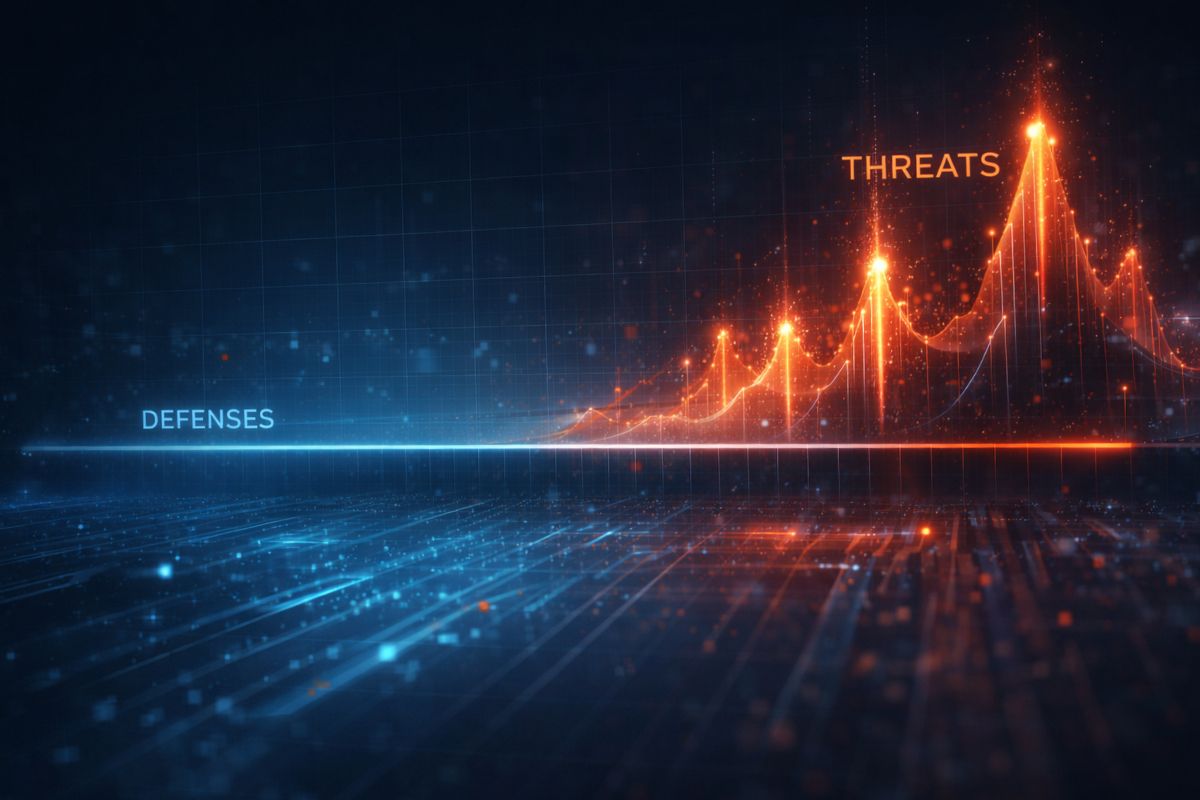
As 2026 approaches, small and medium businesses across Canada and the United States face a cybersecurity environment defined by accelerating threat capability and uneven defensive adoption. Data from insurers, security vendors, and industry surveys converges on a consistent finding. Attack frequency and sophistication are rising faster than the implementation of minimum security controls across most SMBs.
This gap between threats and controls is not abstract. It manifests in higher incident rates, longer recovery times, denied insurance claims, and increased pressure from customers and partners. While advanced attacks receive the headlines, the majority of successful compromises still rely on basic weaknesses. Weak authentication, unprotected endpoints, unpatched systems, and inadequate backups continue to dominate root cause analysis.
In 2026, cyber risk for SMBs is no longer primarily a technology problem. It is a systems and governance problem that requires alignment between infrastructure, process, and behavior.
Threat acceleration is driven by automation and scale:
The most significant change in the SMB threat landscape is scale. Automated scanning tools now continuously probe the internet for exposed services, outdated software, misconfigured cloud resources, and weak credentials. These tools operate without regard to company size, industry, or geography.
Ransomware remains a primary driver of business disruption. The expansion of ransomware as a service has lowered the technical barrier for attackers while standardizing playbooks for intrusion, lateral movement, and extortion. Phishing and credential theft continue to serve as common entry points, increasingly enhanced by artificial intelligence that improves realism and personalization.
Supply chain risk further compounds exposure. SMBs that integrate with cloud platforms, managed service providers, or enterprise customers inherit interconnected risk. A single weak control can propagate impact across multiple organizations.
From a data perspective, the threat curve is steep and persistent. There is no seasonal lull and no practical threshold below which an organization becomes invisible.
Control adoption lags despite repeated incidents:
Despite sustained increases in threat activity, control adoption among SMBs remains inconsistent. Surveys indicate that many organizations report experiencing cyber incidents while simultaneously rating their preparedness as low or moderate. This disconnect suggests a normalization of risk rather than a reduction in exposure.
Budget prioritization plays a central role. Cybersecurity is often treated as a discretionary expense, competing with initiatives perceived as more directly revenue generating. As a result, controls are implemented partially or deferred entirely. Multifactor authentication may be enabled on some systems but not others. Endpoint protection may exist without centralized monitoring. Backups may be present without routine testing.
Responsibility fragmentation exacerbates the issue. In many SMBs, cybersecurity lacks a clear owner. IT tasks are distributed across generalist roles or outsourced without defined accountability for risk management, incident response, or policy enforcement. This structure makes consistent execution difficult and measurement even harder.
Minimum standards are no longer ambiguous:
One of the clearest signals entering 2026 is the convergence around minimum acceptable security controls. These standards are no longer debated in technical forums alone. They are enforced through insurance underwriting, contractual requirements, and regulatory guidance.
Multifactor authentication across all user accounts has become a baseline expectation. Endpoint detection and response has replaced basic antivirus as the default for device protection. Regular patching and vulnerability management are now considered essential, not best practice. Offline or segregated backups are required to support recovery from ransomware and destructive attacks.
Remote and hybrid work models further raise the bar. Centralized device management, secure remote access, and network segmentation are increasingly necessary to manage risk from distributed endpoints.
The practical implication is straightforward. Organizations that do not meet these minimums are operating below the threshold required for resilience in 2026.
Infrastructure quality influences risk outcomes:
Infrastructure age and design materially affect security outcomes. Legacy systems often lack vendor support, timely patching, and compatibility with modern monitoring tools. Automated scanners routinely identify and exploit these environments due to their predictability and exposure.
In contrast, modernized infrastructure enables consistent control enforcement and improved visibility. Cloud managed systems, updated network equipment, and centralized logging support faster detection and response. Redundancy at the network and power level reduces the operational impact of incidents that might otherwise cascade into prolonged downtime.
Data from incident response engagements consistently shows that organizations with modern infrastructure recover faster and incur lower total costs. Infrastructure decisions therefore function as risk multipliers or mitigators, not neutral technical choices.
Cyber insurance has become a critical but conditional component of risk management. Insurers are responding to rising claims by tightening underwriting standards and requiring evidence of specific controls before issuing or honoring policies. These requirements increasingly mirror the minimum standards outlined above.
Organizations lacking documentation of multifactor authentication, endpoint protection, backup practices, and employee training face higher premiums, coverage exclusions, or outright denial. In many cases, failure to maintain stated controls results in denied claims following an incident.
Third party expectations amplify this pressure. Enterprise customers are assessing SMB vendors as part of supply chain risk management. Security questionnaires, audits, and contractual clauses are more common. Failure to meet expectations can result in lost opportunities without explicit explanation.
Cybersecurity is therefore transitioning from an internal concern to a prerequisite for participation in broader commercial ecosystems.
Human factors remain statistically significant:
Despite advances in tooling, human behavior continues to account for a substantial proportion of incidents. Phishing, impersonation, and social engineering attacks exploit routine workflows, authority cues, and time pressure.
Data shows that organizations with regular security awareness training experience lower incident rates and faster response times. Training effectiveness correlates with clarity of process. Employees must understand how to verify requests, where to report concerns, and that questioning unusual activity is encouraged.
As artificial intelligence improves the realism of scams, the human layer becomes more important, not less. Technology can reduce exposure, but it cannot fully compensate for untrained or unsupported staff.
The cost of inaction compounds over time:
The gap between threats and controls has compounding effects. Each deferred control increases the likelihood of an incident and the potential impact when one occurs. Downtime, data loss, reputational damage, and legal exposure rarely occur in isolation. They reinforce one another.
Organizations operating below minimum standards face longer recovery times due to inadequate backups and limited visibility. They also face higher secondary costs, including customer churn, regulatory scrutiny, and increased insurance premiums.
From a financial perspective, incremental investment in baseline controls often yields disproportionate risk reduction. Conversely, delayed investment frequently results in step change losses following a single incident.
Cybersecurity as an operational system:
Data increasingly supports a systems based approach to SMB cybersecurity. Isolated tools provide limited benefit without integration and governance. Effective programs align controls across identity, endpoint, network, data protection, and human processes.
This alignment enables measurement. Organizations can track control coverage, incident frequency, and response effectiveness. Measurement supports prioritization and continuous improvement rather than reactive spending.
Importantly, systems based security supports growth. Organizations with stable security foundations adopt new tools faster, integrate partners more confidently, and respond to change with less friction.
Conclusion closing the gap in 2026:
The data is unambiguous. In 2026, the primary cyber risk facing SMBs is not the absence of advanced defenses. It is the absence of minimum controls implemented consistently across the organization.
Threats are accelerating due to automation and scale. Expectations are rising due to insurance, regulation, and supply chain pressure. Tools are more accessible than ever, reducing barriers to adoption.
The remaining challenge is execution. Closing the gap between threats and controls requires clear ownership, defined standards, and disciplined implementation. SMBs that address cybersecurity as an operational system rather than a collection of tools will be better positioned to reduce risk, recover quickly, and compete effectively.
The gap is measurable. It is closing for some organizations and widening for others. In 2026, that difference will increasingly determine resilience, credibility, and long term viability.












No Comments