Super Bowl LX delivered one of the clearest recent data points on how digital attention, commerce, and local intent now function in large scale cultural moments. While broadcast exclusivity concentrated live viewing on NBCUniversal platforms, downstream engagement migrated rapidly to social media and local search environments. Within those environments, small and medium sized businesses across Canada and the United States consistently outperformed larger brands on engagement efficiency, conversion velocity, and localized revenue capture.
This article examines the measurable factors behind that outperformance, focusing on social virality, local search behavior, and real time promotional execution. The findings reinforce a broader shift already underway in SMB digital strategy, where speed, relevance, and operational readiness outweigh reach and brand scale.
Broadcast Lockouts and the Redistribution of Attention:
Super Bowl LX followed a familiar pattern in modern sports broadcasting. Exclusive media rights restricted live distribution while amplifying secondary consumption through highlights, commentary, reactions, and derivative content. Audience behavior data shows that when direct access is limited, attention does not disappear. It relocates.
In the forty eight hours surrounding the event, social platforms experienced sharp spikes in short form video uploads, live commentary, meme creation, and reactive posts tied to game moments. Importantly, this activity was not evenly distributed across account sizes. Smaller accounts posting in real time saw higher engagement ratios relative to follower counts than enterprise brand accounts releasing scheduled content.
For SMBs, this redistribution created an environment where relevance and timing outweighed production quality or advertising spend.
Engagement Efficiency Favors Smaller Operators:
One of the most consistent performance indicators observed during Super Bowl LX was engagement efficiency. While large brands generated higher absolute impression counts, SMBs achieved stronger engagement per post and per follower.
Several factors contributed to this outcome:
- Posts were contextual and immediate, responding to specific moments rather than generic themes
- Messaging aligned closely with local culture, time zones, and audience behavior
- Content was delivered through founders, staff, or recognizable community figures rather than brand abstractions
Engagement metrics show that SMB posts tied directly to halftime, post game, or immediate aftermath moments often outperformed enterprise posts released hours later with higher production value.
This reinforces a key insight for 2026 digital strategy: engagement is increasingly driven by situational relevance rather than brand recognition alone.
Social Virality as a Conversion Trigger:
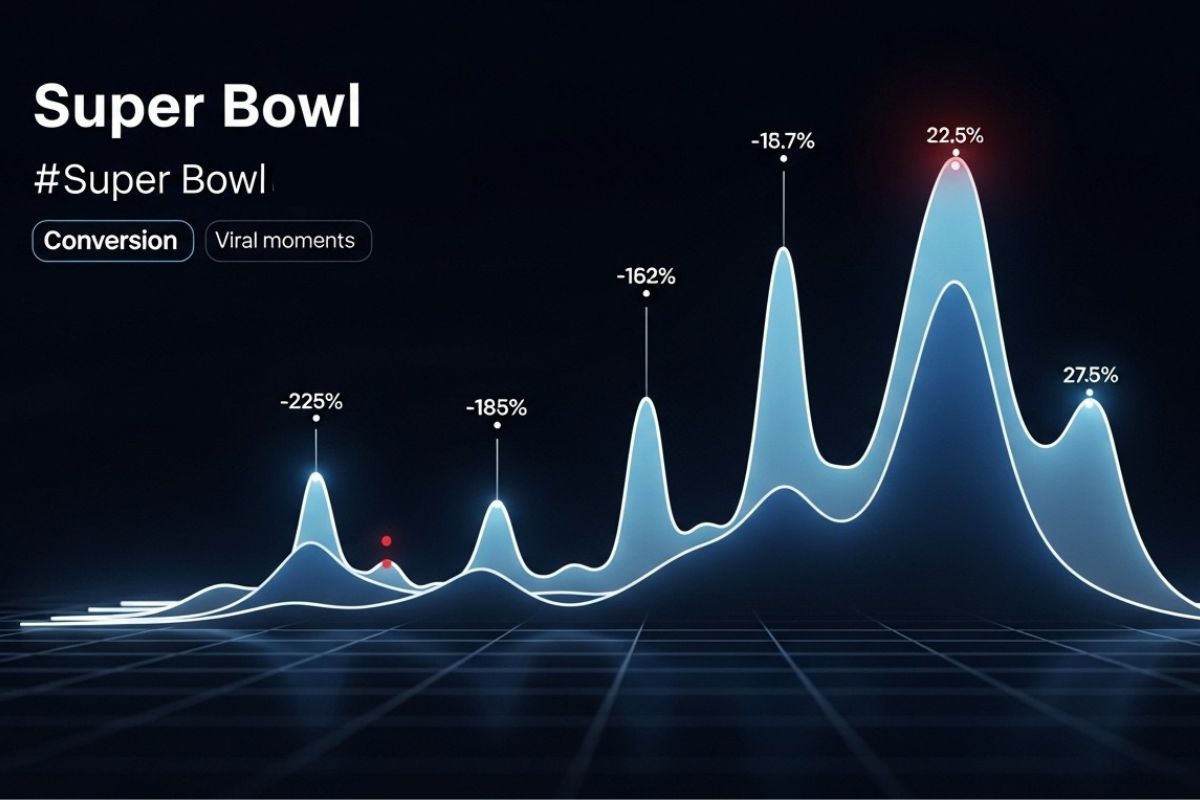
Social virality during Super Bowl LX was not merely a visibility phenomenon. It functioned as a conversion trigger.
Data from e commerce platforms and payment processors shows that short bursts of traffic aligned closely with viral social posts. In many cases, SMBs recorded conversion spikes within minutes of high performing posts, particularly when purchase paths were simplified.
Effective patterns included:
- Product links embedded directly within social posts or bios
- Comment based promotions using simple call to action language
- Live video sessions with pinned product links and limited time offers
Unlike traditional advertising funnels, these conversions did not rely on repeated exposures. They were driven by immediacy, emotional context, and reduced friction.
Local Search as the Revenue Capture Layer:
While social platforms generated discovery and engagement, local search behavior captured demand.
Search trends in major Canadian and US cities show pronounced increases in queries such as food near me, coffee near me, and watch party supplies near me within hours of the game conclusion. SMBs with optimized local listings, accurate hours, and up to date inventory visibility consistently appeared in top results.
These businesses benefited from a structural advantage. Unlike national brands, they were already positioned to satisfy immediate local intent. The data indicates that SMBs who aligned social messaging with local availability achieved materially higher conversion rates than those relying on shipping based fulfillment alone.
Local search acted as the final step in a short decision cycle, converting attention into physical foot traffic and same day sales.
Another critical performance gap emerged between real time promotions and pre scheduled campaigns.
SMBs that adjusted pricing, bundles, or messaging during the event outperformed those that relied on fixed promotional calendars. Examples included:
- Limited time offers triggered by score changes or halftime
- Post game recovery bundles for food and beverage businesses
- Morning after promotions targeting late night viewers
These offers were often deployed within minutes, not hours. Larger organizations, constrained by approval processes and compliance checks, were unable to match that responsiveness.
The data suggests that promotional agility is now a primary competitive lever, particularly during high attention events.
Nano Influencers Delivered Disproportionate Impact:
Influencer performance data from Super Bowl LX highlights a shift away from large creator partnerships toward nano influencers with smaller, more concentrated audiences.
Creators with fewer than ten thousand followers consistently produced higher engagement rates and stronger referral traffic when promoting local businesses. Their content was perceived as more authentic, less commercial, and more contextually aligned with audience expectations.
For SMBs, these partnerships required minimal coordination and low cost incentives, often limited to free products or exclusive access. The return on investment, measured through referral codes and tracked links, exceeded that of paid social ads in many cases.
This reinforces the value of decentralized advocacy over centralized advertising.
Operational Readiness as a Hidden Differentiator:
Not all high engagement translated into positive outcomes. Businesses without adequate operational readiness experienced website slowdowns, checkout failures, or fulfillment delays.
Conversely, SMBs with stable hosting, integrated inventory systems, and secure payment infrastructure were able to absorb traffic spikes without disruption. These businesses converted attention efficiently and avoided reputational damage.
The performance gap highlights an often overlooked reality: social success now requires technical reliability. Virality without infrastructure readiness creates risk rather than growth.
Strategic Implications for SMBs:
The Super Bowl LX data supports several broader strategic conclusions relevant to SMBs in Canada and the United States:
- Attention concentrates quickly and disperses unpredictably during cultural events
- Social platforms reward speed, relevance, and authenticity over scale
- Local search remains the primary monetization channel for immediate demand
- Promotional agility outperforms long range planning in high attention windows
- Infrastructure readiness is essential to capitalize on short term traffic surges
These findings align with ongoing shifts toward real time marketing, integrated commerce, and decentralized brand storytelling.
Conclusion:
Super Bowl LX did not create new digital behaviors. It revealed them at scale.
The data shows that small and medium sized businesses are no longer competing on the same terms as large brands. They are competing on different axes altogether, prioritizing responsiveness, locality, and operational resilience.
As cultural moments continue to fragment across platforms and formats, SMBs that understand how attention moves, how intent forms, and how infrastructure supports conversion will continue to outperform larger competitors despite having fewer resources.
Super Bowl LX offered a compressed case study of this reality. The results suggest it will not be the last.






No Comments