The data points to a structural change
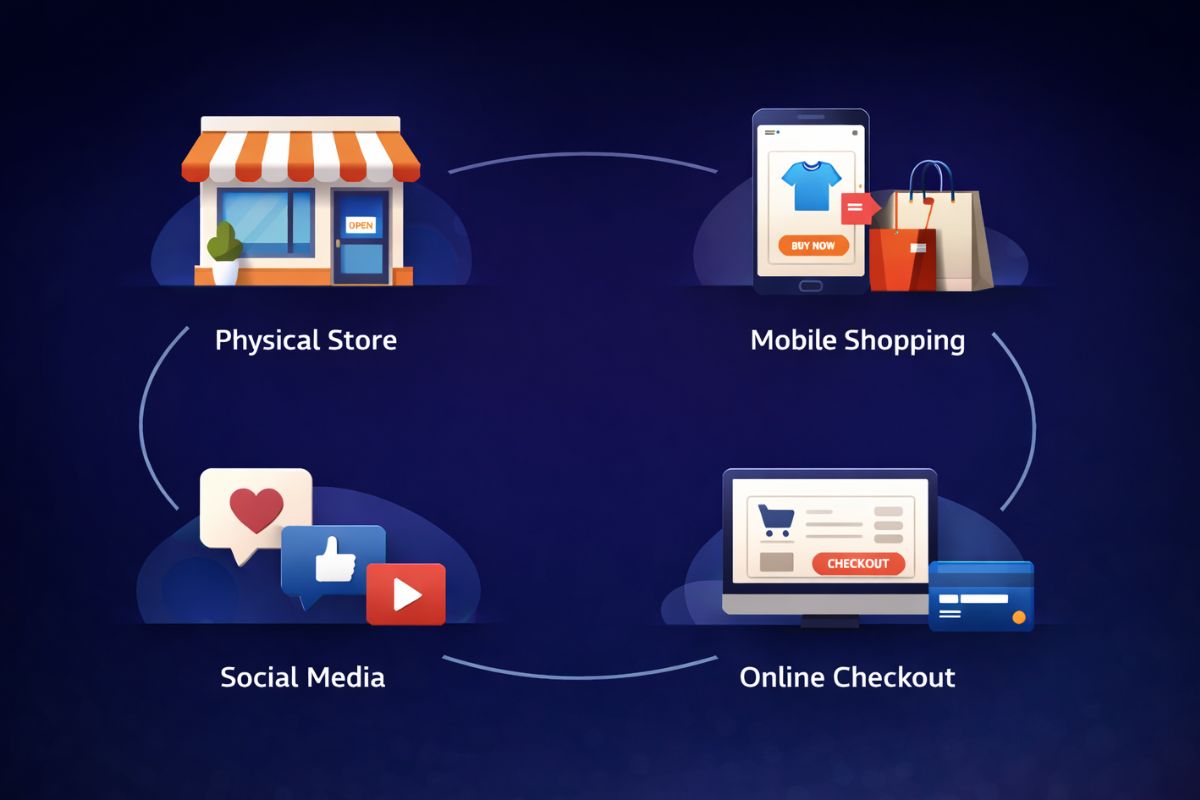
By 2026, small and medium businesses across Canada and the United States are no longer debating whether e-commerce and social commerce matter. The data now shows a more significant shift underway. SMBs are moving away from managing isolated digital channels and toward building integrated commerce systems that connect sales, payments, customer data, and loyalty into unified operational frameworks.
This transition is not driven by preference or trend adoption alone. It is a response to measurable changes in consumer behavior, platform design, and competitive benchmarks. Customers interact with businesses across multiple touchpoints, often within the same day, and expect continuity across each interaction. Businesses that fail to connect these touchpoints experience lower conversion, weaker retention, and higher operational friction.
The evidence suggests that performance gaps between SMBs are increasingly determined by system maturity rather than channel presence.
Mobile first behavior reshapes the commerce baseline:
Mobile commerce now defines the baseline experience against which all other interactions are evaluated. Data from retail and platform analytics consistently shows that the majority of product discovery, comparison, and purchasing activity occurs on mobile devices.
This has direct implications for system design. Businesses optimized for desktop workflows struggle to meet mobile performance benchmarks. Slow load times, complex navigation, and multi step checkout processes result in abandonment at statistically significant rates.
SMBs that prioritize mobile first architecture show stronger conversion metrics and higher repeat engagement. This includes streamlined interfaces, simplified checkout, stored payment credentials, and biometric authentication where supported. These elements are no longer advanced features. They are expected components of a functional commerce system.
Mobile behavior also influences how quickly customers move from awareness to transaction. Shorter decision windows place pressure on businesses to reduce friction across every system dependency.
Also Read: Five Small Business Marketing Trends to Watch in 2026
Social commerce as a transactional layer:
Social platforms have evolved from distribution channels into transactional layers embedded directly within the customer journey. In app checkout, native product catalogs, and integrated payment processing allow customers to complete purchases without leaving the platform environment.
From a systems perspective, this introduces new requirements. Inventory availability, pricing consistency, and order fulfillment must synchronize in near real time across social storefronts and primary commerce platforms. Manual reconciliation is not scalable.
Data indicates that SMBs with integrated social commerce systems outperform those treating social platforms as referral traffic sources. Conversion rates improve when customers are not required to transition between platforms. Attribution clarity also improves, allowing businesses to assess performance with greater accuracy.
The operational implication is clear. Social commerce must be treated as part of the core transaction stack rather than an external marketing function.
Historically, SMBs adopted digital tools incrementally. One platform for online sales, another for payments, a separate loyalty program, and manual processes to bridge the gaps. This approach created fragmentation that limited scalability and obscured performance insights.
In 2026, leading SMBs are consolidating these functions into unified commerce systems. Inventory management, customer profiles, payment processing, loyalty data, and fulfillment options are increasingly managed within connected platforms or tightly integrated ecosystems.
The benefits of this consolidation are measurable. Unified systems reduce operational overhead, minimize data inconsistencies, and enable more accurate forecasting. They also support customer expectations for flexible fulfillment options such as buy online and pick up in store, curbside pickup, and local delivery.
Importantly, system integration enables consistency. Customers encounter the same pricing, availability, and service options regardless of entry point. This consistency directly correlates with higher trust and repeat purchase rates.
Payments as a conversion variable:
Payment performance has emerged as a statistically significant factor in conversion outcomes. Data shows that limited payment options and complex checkout processes contribute to cart abandonment at late stages of the purchase journey.
SMBs offering modern payment methods, including digital wallets and stored credentials, demonstrate higher completion rates. Faster checkout experiences reduce cognitive friction and shorten transaction time, which is particularly important in mobile contexts.
From a systems perspective, payments are no longer a back office function. They are an integral part of the customer experience and must integrate seamlessly with inventory, order management, and loyalty tracking.
Businesses that treat payments as a modular add on rather than a core system component consistently underperform peers with integrated payment architectures.
Loyalty programs are undergoing a measurable shift in function. Traditional discount based models generate short term engagement but fail to support long term retention. Data indicates that customers respond more positively to loyalty systems that emphasize recognition, ease of repeat purchase, and personalized incentives.
Digital loyalty systems integrated with customer profiles allow SMBs to analyze purchasing behavior and tailor engagement accordingly. This enables targeted rewards, early access, and simplified reordering without eroding margin through constant discounting.
Retention metrics improve when loyalty systems are embedded within the broader commerce infrastructure rather than managed separately. This integration allows loyalty data to inform marketing, inventory planning, and customer service interactions.
Artificial intelligence reduces execution variance:
One of the most significant variables affecting SMB performance in 2026 is the adoption of AI enabled tools. These tools are no longer experimental or exclusive to large enterprises. They are embedded within many commerce, marketing, and customer support platforms used by SMBs.
AI contributes to operational efficiency through automation of routine tasks such as content generation, customer inquiry handling, ad optimization, and demand forecasting. This reduces execution variance between businesses with different resource levels.
Data shows that SMBs using AI to support decision making achieve faster response times and more consistent performance outcomes. However, AI effectiveness correlates strongly with system integration. Tools deployed in isolation deliver limited value.
The practical takeaway is that AI functions best as an extension of unified systems rather than as a standalone capability.
The Canadian and cross border performance context:
Canadian SMBs operate within a competitive environment shaped by cross border commerce. Consumers increasingly compare domestic businesses to international alternatives based on experience quality rather than geographic proximity.
This comparison elevates performance expectations. Canadian businesses with integrated systems that support transparency, speed, and flexible fulfillment demonstrate stronger retention, even in categories exposed to global competition.
Public and private sector digital adoption initiatives have increased access to commerce tools and advisory resources. As a result, the performance gap between SMBs is increasingly defined by execution quality rather than tool availability.
As access to advanced tools expands, baseline expectations rise accordingly. Customers assume seamless experiences. Platforms assume real time synchronization. Competitive benchmarks adjust rapidly.
In this environment, incremental improvements to individual channels yield diminishing returns. System level optimization becomes the primary driver of sustainable growth.
SMBs that continue to operate with fragmented tools face compounding inefficiencies. Those that invest in unified systems gain clarity, flexibility, and resilience.
Conclusion A systems first model defines 2026 competitiveness:
The data supports a clear conclusion. The future of SMB e commerce in Canada and the United States is defined by systems, not channels.
Mobile first behavior, social commerce integration, modern payments, loyalty infrastructure, and AI enabled automation are converging into unified commerce models. These models reduce friction, improve insight, and align operational execution with customer expectations.
In 2026, competitive advantage is not determined by platform presence alone. It is determined by how effectively those platforms are connected. SMBs that adopt a systems first approach position themselves to meet rising performance standards with consistency and confidence.
The shift from channels to systems is not theoretical. It is already measurable. And it is redefining how small and medium businesses compete in a data driven marketplace.










No Comments