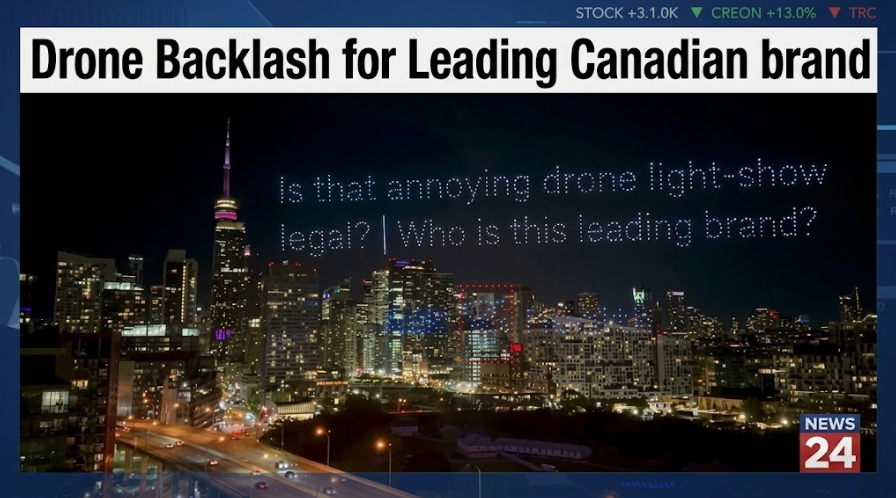
When more than 1,000 drones appeared over Toronto’s waterfront on September 10, the most obvious question was what they were advertising.
The harder question came afterward: what rules allow a company to turn a section of the night sky into a commercial message?
The display near Fort York formed health-related questions before showing a QR code promoting PC Chat, an AI-powered health information service from PC Health. CBC reported that the show started at about 11 p.m. and lasted around 15 minutes. Residents later criticized the display as intrusive and dystopian, while online discussion raised concerns about advertising in shared public space.
The public reaction created a simple narrative: brand launches drone ad, residents object.
The regulatory picture is more specific.
The City of Toronto had permitted the activation above Fort York National Historic Site. Loblaw Companies Limited said the required permits had been obtained. Transport Canada confirmed to CBC that it issued a Special Flight Operations Certificate for the campaign.
So this was not an illegal swarm appearing without authorization.
That fact, however, does not settle the larger question.
What Was Actually Authorized?
The City of Toronto posted a notice advising that it had permitted a drone light-show activation above Fort York on the evening of September 10.
That establishes municipal permission for the use of the site.
Transport Canada regulates aviation safety. Its current drone rules classify certain operations involving multiple drones as special operations. According to Transport Canada, flying more than five drones within visual line of sight can fall within the medium-complexity special-operations category. Drone shows can also require a Special Flight Operations Certificate under rules for special aviation events.
Transport Canada told CBC that it issued an SFOC for the PC Health campaign, although it did not disclose the underlying application because of privacy requirements.
That is an important correction to the common assumption that the controversy reflected a failure to obtain approval.
The evidence available publicly points in the opposite direction.
The campaign was authorized through the relevant channels.
What Does a Permit Not Decide?
A permit can answer questions about legal authority, aviation safety and use of a site.
It does not answer whether residents will regard the activation as appropriate.
This distinction is where the story becomes more complicated.
The people criticizing the campaign were not necessarily arguing that the drones had flown without paperwork. Their complaints focused on the character of the advertising: its scale, movement, visibility and presence in an environment that people do not normally treat as commercial media.
Urban planner Sean Galbraith told CBC that the dynamic nature of the display made it especially disruptive. Toronto resident Jessica Matheson said the advertising felt unavoidable and argued that companies should consider boundaries in how they market to people.
Those criticisms move the debate away from aviation rules and toward public-space norms.
That is a much less settled area.
Is the Sky a Public Space?
The phrase “public space” is useful but imprecise here.
The airspace above a city is regulated. Property below it has owners and users. Municipal governments control many locations from which events are staged. Aviation authorities regulate how aircraft are operated.
But none of that creates a simple answer to the cultural question: how much commercial messaging should people encounter in the visual environment around them?
Cities already contain advertising on buildings, transit shelters, vehicles, stadiums and roadside structures. Digital screens have increased the amount of moving commercial imagery in many downtown areas.
Drone shows extend that logic vertically.
The difference is psychological as much as physical. People are accustomed to looking at a building and seeing a sign. They are less accustomed to looking at the sky and seeing a QR code.
That novelty is why the medium works. It is also why it provokes resistance.
Why the Health Context Matters?
The campaign promoted PC Chat, which Loblaw describes as an AI-powered health information service built around Canadian clinical guidelines and more than 1,000 Canadian clinical sources.
PC Health says health conversations are stored in Canada. The service can use connected health information to provide more personalized responses and can direct users toward pharmacists and other care options when appropriate.
That product context matters because the debate is not only about drones.
Health services depend heavily on trust. AI systems introduce additional questions about data, reliability and appropriate use. A campaign that feels intrusive to part of the audience can create tension with a product that asks users to engage with potentially sensitive information.
This does not prove the campaign damaged trust. No public evidence reviewed for this article establishes a measurable change in consumer sentiment toward PC Chat.
What can be said is narrower: the campaign caused some public discussion to shift from the utility of the service to the appropriateness of the advertising medium.
That is a real communications outcome, even if its long-term commercial effect is unknown.
Could the Same Thing Happen in the United States?
A similar campaign in the United States would face a different regulatory system but comparable operational questions.
The Federal Aviation Administration regulates small unmanned aircraft under Part 107. Its rules identify operations involving multiple small drones with one remote pilot as an activity that can require a waiver. Other requirements can apply depending on altitude, airspace, operations over people, visibility and other conditions.
That means a large commercial drone show is not simply a creative purchase. It involves a regulated aviation operation.
For businesses, the practical lesson is that vendor credentials matter. Companies should know who is operating the aircraft, which approvals are required, what insurance is in place, how flight safety is managed and who has authority to stop the event.
The sponsor’s name may be the one the public remembers even when a specialist vendor handles the flight.
What the Evidence Does Not Show?
Several claims should not be overstated.
The public evidence reviewed here does not establish that the drone display created an actual traffic incident. One social media user raised concern about distraction, but that is not the same as a documented collision or safety violation.
The evidence also does not establish that most Toronto residents opposed the campaign. CBC reported criticism from specific residents and social media users. That is evidence of backlash, not a scientific measure of citywide opinion.
There is also no public evidence yet showing whether the controversy helped or hurt adoption of PC Chat.
These gaps matter.
A high-profile reaction can be commercially positive, negative or mixed. Earned media can increase awareness even when the framing is critical. Without usage data, sentiment research or campaign metrics, claims about success or failure would be speculative.
The Real Question Is Governance of Shared Attention
The Toronto incident is most useful when treated as a governance question rather than a morality play.
The campaign was permitted. The technology worked. The message was seen. Some residents objected.
All of those facts can be true at the same time.
As advertising technology moves into new physical environments, governments and communities may eventually debate whether existing rules adequately address commercial use of those spaces. Aviation regulation is designed primarily around safety. Municipal permitting can address event use and location. Neither automatically resolves broader questions about visual intrusion, nuisance or the commercialization of shared environments.
For now, brands are operating in the gap.
That means businesses considering drone advertising or other high-impact experiential media need to answer more than “Is it legal?”
They also need to ask who will be exposed, whether those people have chosen to participate, what the surrounding location means, how the format fits the product and what reaction the campaign could trigger once it leaves the control of the marketing team.
The Toronto display did not prove that drone advertising should be prohibited.
It did prove that a permit is not the end of the conversation.








Comments are off for this post.