Meta has built substantial safeguards into Muse, but the agent’s capabilities, training policy, patched vulnerability and human-concierge test deserve precise examination
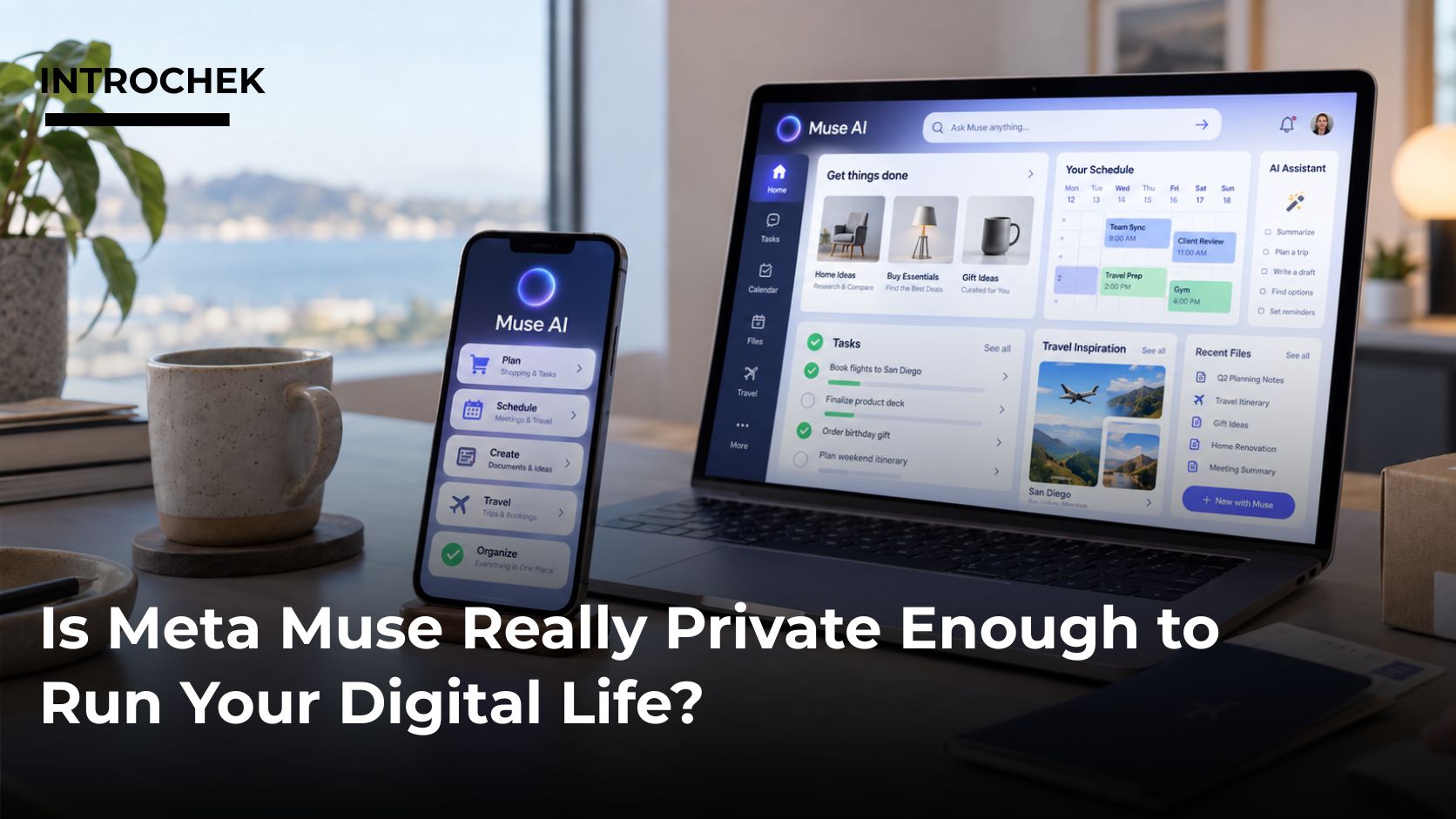
Meta’s Muse is being marketed as a personal AI agent that can do far more than answer questions.
It can browse websites, fill forms, send messages, book travel, negotiate and make purchases. That is the appeal. It is also why privacy and security questions around Muse deserve a higher standard than the questions surrounding an ordinary chatbot.
A chatbot can be wrong.
An agent can be wrong and then act.
Meta has published unusually detailed security documentation for Muse. The company says the agent uses a dedicated cloud virtual machine, separates credentials from the main agent, relies on a Sentinel component to authorize sensitive activity and asks users to approve consequential actions such as purchases.
Those are meaningful controls.
They do not settle the privacy question.
The more useful way to assess Muse is to separate four issues that are often collapsed into one: what the agent can access, how it stores credentials and activity, how Meta can use the resulting data and what happens when the system makes a mistake.
What can Muse actually access?
Meta says Muse becomes more capable when users connect services and allow it to operate across the web.
That can include email, calendars, websites and transaction workflows.
The practical privacy implication is obvious. A useful personal agent may need access to information that is far more sensitive than the prompts people casually type into a chatbot.
That creates an important distinction between data visibility and data authority.
An agent may need to read information to complete a task.
It may also need permission to send a message, make a booking or purchase something.
Those are different permission levels and should be treated differently.
Meta says Muse supports graduated permissions and human approvals for sensitive actions. The question for users is whether those settings are understandable enough to produce informed decisions rather than blanket access.
A system can have strong technical protections and still create risk if users do not understand what they are authorizing.
One of Meta’s strongest documented safeguards is the separation of credentials from the main agent.
According to the company’s security material, Muse operates inside a dedicated cloud virtual machine. Credentials are stored in a way that keeps the underlying secrets hidden from the agent itself. A separate Sentinel system evaluates network access and authorizes certain actions.
This design addresses a core agent-security problem.
If an AI system can read raw passwords or tokens directly, a prompt-injection attack could potentially trick the agent into exposing them. Keeping credentials outside the model’s direct view reduces that risk.
Meta also says users can revoke access to connected services.
These are not superficial controls. They show that the company recognizes that an action-taking AI requires a different architecture from a general-purpose chatbot.
But security architecture should be assessed alongside the system’s acknowledged limitations.
Prompt injection remains an open problem
Meta’s own security documentation says Muse will make mistakes and that prompt injection remains an unresolved industry problem.
Prompt injection occurs when an AI system encounters malicious or misleading instructions embedded in content it is reading and treats those instructions as something it should follow.
For a chatbot, that can produce a bad answer.
For an agent, the concern is larger because the agent may have permission to visit sites, use connected services or perform actions.
Meta says Sentinel and other controls are intended to limit the consequences of such attacks.
The important point is that the company does not claim the problem has been solved.
That is a more useful basis for evaluating Muse than either extreme claim that the system is completely safe or inherently unsafe.
The patched Mac vulnerability is a useful test case
On September 22, The Verge reported that Meta issued a hotfix for a vulnerability in the Muse Mac application after security researcher Patrick Wardle demonstrated a method that could redirect part of the agent’s processing.
Meta said exploitation required malicious software already running locally on the user’s computer.
That qualification matters.
A vulnerability that requires pre-existing local malware is not equivalent to a remote attacker taking control of Muse from anywhere on the internet.
At the same time, the incident illustrates the broader risk model surrounding agents.
Once software can act across connected services, application-level vulnerabilities deserve close attention because the potential consequences extend beyond generating incorrect text.
The episode also shows the value of rapid disclosure and patching. A single reported flaw does not establish that a product is broadly insecure. It does demonstrate why ongoing scrutiny is necessary.
Are Muse conversations used for advertising?
This is one of the easiest areas to oversimplify.
Meta says Muse conversations and data stored in the agent’s virtual machine are not shared directly with its advertising systems.
That is a specific claim.
It should not be converted into the broader statement that Muse activity can never influence advertising.
Meta’s documentation explains that when Muse browses a website, the site may treat that visit as the user’s activity. That activity can then affect how the external service behaves, including advertising or personalization outside Muse.
The distinction matters.
Direct sharing from Muse to Meta’s ad systems is one question.
Downstream observation of Muse’s browsing activity by other services is another.
Privacy analysis becomes misleading when those questions are merged into one yes-or-no label.
What about model training?
Meta says sanitized interaction trajectories can be used to improve its models unless the user opts out.
That wording deserves attention.
A trajectory is more than a single prompt. It can describe the sequence of steps an agent takes while completing a task.
Meta says the data is sanitized, and the company provides an opt-out.
The important user question is whether the information contained in those trajectories can be sufficiently separated from sensitive context before it is used for model improvement.
Meta’s published documentation provides the policy direction, but independent evidence about long-term implementation is naturally limited because Muse has only just launched.
That is an area where users and businesses should avoid stronger conclusions than the evidence supports.
The human-concierge test complicates the idea of an AI-only workflow
Reuters reported on September 22 that Meta is internally testing a human-concierge capability for some Muse phone calls.
Under the test, human contractors may conduct calls initiated through Muse when automation cannot complete the task.
Meta said the test is internal and intended to improve privacy and safety before wider release. It is not currently a general public Muse feature.
Even so, the experiment raises an important transparency question.
If a user believes an AI system is making a call, should they be told when a human contractor is participating?
If a business receives that call, should the employee know whether they are speaking with software, a contractor or a workflow that can shift between both?
The answers matter for disclosure, consent, call recording and the sharing of account information.
The test does not prove that Muse routinely hands conversations to humans. It does show that agentic services may combine automation and human labor in ways users need to understand.
Security and privacy are not the same thing
Another common mistake is treating strong security controls as proof of broad privacy.
Security asks whether data and permissions are protected against unauthorized access or misuse.
Privacy asks who can collect the data, how it is used, how long it is retained and who else can observe the activity.
Muse can have strong credential isolation and still raise legitimate privacy questions about training data, connected services and downstream tracking.
The reverse is also true. A restrictive privacy policy is not enough if the software has technical vulnerabilities.
A serious evaluation needs both.
Businesses should ask more than whether Muse is secure
For organizations, the relevant questions extend beyond employee use of the app.
Muse and similar agents may also arrive as customer representatives.
A business may receive a booking, purchase request or phone call initiated by an agent.
That means companies need to think about what information they disclose to automated representatives and what evidence they require before changing customer accounts.
A useful checklist includes:
What information can an agent obtain without authentication?
What actions require stronger verification?
Can employees identify when they are dealing with an automated agent?
What customer data is exposed during an AI-mediated transaction?
How are agent actions logged for dispute resolution?
What happens if the agent makes an error?
These questions apply regardless of whether Muse becomes the dominant platform.
The Canadian context requires caution
Meta currently describes Muse as rolling out in the United States.
That means Canadian users and businesses should not assume that U.S. adoption data reflects broad current Canadian use.
However, Shopify’s agentic-commerce infrastructure already includes merchant contexts relevant to Canada, and multiple AI providers are developing action-oriented agents.
The privacy and governance questions are therefore likely to reach Canadian organizations through commerce platforms and other agents even if Muse itself is not yet widely available domestically.
So, is Muse private enough?
There is no single factual answer that applies to every user because the risk depends on what services are connected, what permissions are granted and how sensitive the tasks are.
What can be said from the available evidence is more precise.
Meta has implemented significant security controls around credential isolation, virtual machines, permissioning and human approval.
Meta also acknowledges unresolved risks including prompt injection and agent mistakes.
The company says Muse data is not shared directly with its advertising systems, while also explaining that browsing activity can have indirect effects through external websites.
Meta says sanitized interaction trajectories may be used for model improvement unless users opt out.
A reported Mac vulnerability was patched, with Meta saying exploitation required local malicious software.
An internal human-concierge test shows that some future workflows may involve people as well as software.
That evidence does not support a simple verdict.
It supports a more useful conclusion: Muse has been designed with serious safeguards, but the level of authority users grant it should still be proportional to the sensitivity and consequence of the task.
Sources: Meta security documentation, Meta launch materials, Reuters and The Verge. Publication date: September 23, 2026.











Comments are off for this post.