Grok Bot is marketed around a compelling idea: create persistent AI workers, give them jobs, connect the tools they need and let them continue working even after you step away.
That sounds like autonomy.
But how autonomous is the product in practice?
A closer look at the architecture, approval model, pricing and beta limitations shows a more useful answer. Grok Bot can perform genuine multi-step work across real software, but its autonomy is bounded by shared infrastructure, account permissions, human checkpoints, website restrictions and an operating model that still requires supervision.
That does not make the product less significant.
It makes the details more important.
What Is Actually Persistent?
The core product is different from a conventional chatbot because work does not reset after every conversation.
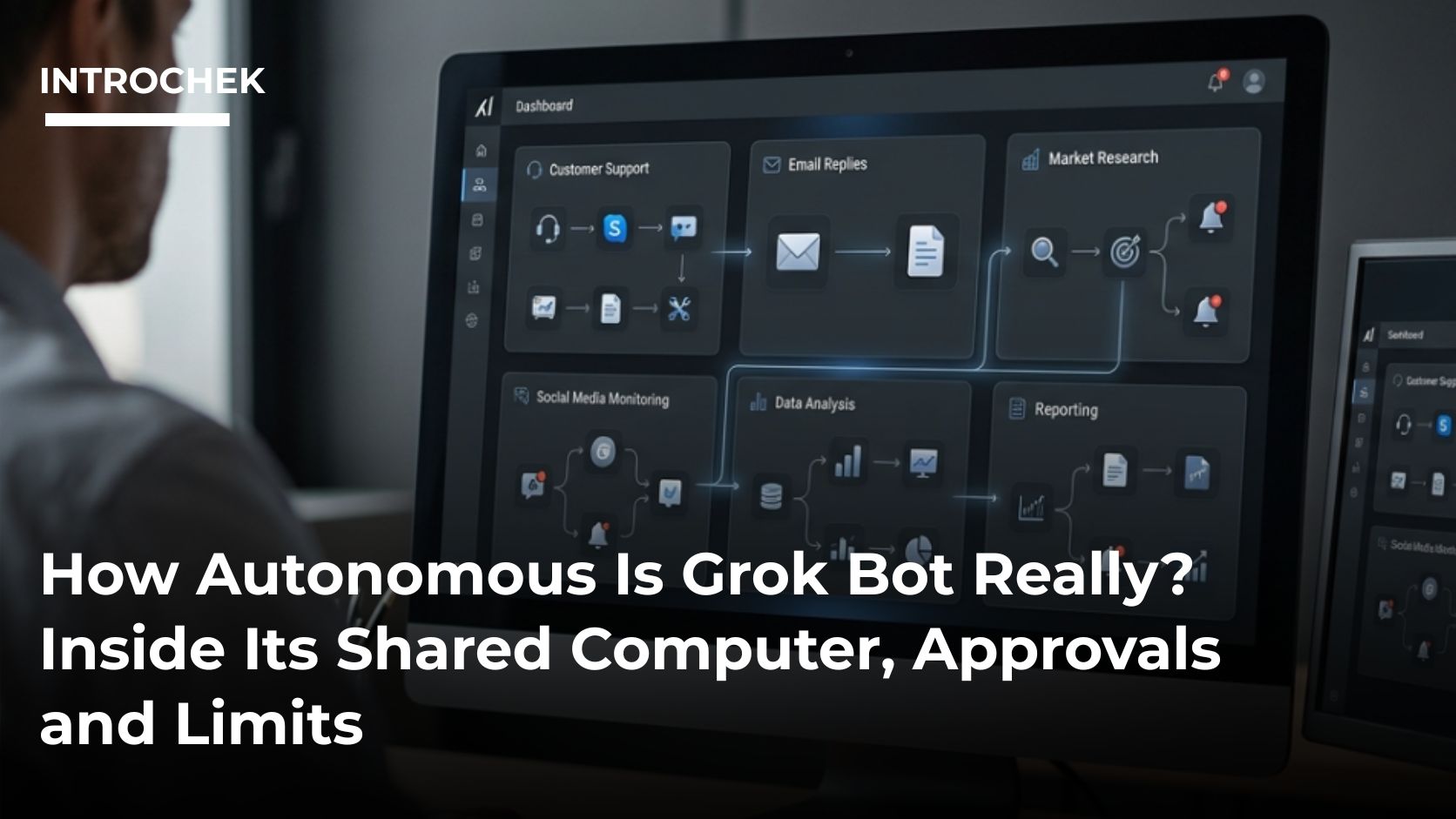
Bots operate through a persistent cloud computer with browser access, files and a terminal. They can retain context across sessions and continue tasks while the user is offline.
A successful process can also be stored as a reusable skill and later run as a routine.
Those capabilities are real and materially different from ordinary prompt-and-response AI.
The important architectural detail is that all Bots belonging to one user share the same cloud computer.
That means the persistence is broader than an individual Bot’s conversation.
Files, browser sessions and command-line credentials can remain available across the Bot roster.
Is Each Bot a Separate Security Boundary?
No.
This is one of the most important points in the official documentation.
Separate Bots may have different names, job descriptions and instructions, but they should not be treated as isolated security environments.
That distinction matters because the interface can encourage a human analogy.
Users may think of a “Sales Bot” and a “Finance Bot” as two separate digital employees.
Operationally, however, they can still share the same underlying computer environment.
A company that wants strong separation cannot rely on naming alone.
It needs account-level controls, scoped credentials, least-privilege access and disciplined handling of files and sessions.
What Does the Approval System Actually Control?
Grok Bot includes approval controls and an Auto Review system.
The purpose is to stop or inspect actions before they happen.
Official guidance recommends explicit review boundaries for sending messages, publishing, purchasing, transferring money, deleting or overwriting data, changing permissions, modifying production systems and accepting legal terms.
This is meaningful.
It also reveals a limit to the “fully autonomous coworker” framing.
A well-configured business deployment is not supposed to allow every consequential action to proceed automatically.
The product is designed to support selective autonomy.
Research may be automatic.
Drafting may be automatic.
A sensitive action may pause for review.
That is not a weakness. It is a safety architecture.
But it means any claim that Grok Bot simply replaces a human operator should be treated carefully.
Can It Handle Passwords and Two-Factor Authentication?
Not in the way some automation marketing might imply.
The documented approach is for the Bot to hand control to the user when a password, passkey, two-factor code, CAPTCHA or payment confirmation is required.
The human completes the sensitive step and returns control.
This is another practical boundary.
Some workflows can continue for long periods without intervention.
Others will hit authentication or anti-automation checkpoints.
A scheduled routine is therefore not automatically a zero-touch routine.
Businesses should measure the frequency of these handoffs rather than assuming they disappear.
What Happens When Websites Resist Automation?
Websites remain an external constraint.
They can change interfaces, expire sessions, block automation, present CAPTCHAs or require a person to take over.
Grok Bot can interact with browsers, but it does not have unilateral authority over the systems it visits.
This creates a reliability issue that has little to do with model intelligence.
An agent can reason correctly and still fail because the page changed.
That is why workflow testing matters more than a general claim that the model is capable.
What Is Known About Reliability?
The product is still beta.
Official documentation provides detailed examples of how to build roles, skills and routines, but there is not yet a mature body of independent benchmarking that establishes long-run success rates across common business workflows.
Independent reviews describe useful delegation and real computer-use capability, while also noting unresolved questions around reliability, quota consumption, session behavior and supervision.
That means the strongest claims should remain narrow.
It is reasonable to say Grok Bot can perform multi-step workflows.
It is not yet reasonable to say those workflows will remain consistently reliable across every business environment.
What Is the Shared Computer Risk?
The shared cloud computer deserves more attention than it usually receives in product overviews.
If multiple Bots share files, browser sessions and credentials, then a business must treat the computer itself as the important trust zone.
That leads to several practical controls.
Use dedicated accounts where possible.
Prefer read-only or scoped access for early pilots.
Remove temporary sensitive files.
Sign out of services that are no longer required.
Do not connect high-risk systems merely because another Bot may need them later.
Review accumulated access periodically.
These are conventional security practices.
The novelty is that they now apply to persistent AI workers.
What About Privacy?
Grok Bot requires cloud data storage and does not support Cursor’s Legacy Privacy Mode.
Applicable training and privacy behavior depends on the account configuration and provider terms.
For businesses handling regulated, customer, financial or employee information, that is not a footnote.
The relevant question is not only what information the Bot sees during one task.
It is what data is stored, what sessions remain active, what files persist in the shared environment and which account settings govern provider use of that information.
Those questions should be answered before production systems are connected.
How Much Does the Autonomy Cost?
Grok Bot is not currently sold as a separate standalone subscription.
Access is bundled through eligible Cursor plans and can also be linked through qualifying SuperGrok and X subscription routes.
Cursor’s current individual pricing begins at $20 per month for Pro, with larger allowances at higher tiers. Included Grok Bot usage resets weekly, and additional usage can be available on demand.
The cost structure matters because autonomous routines can consume usage continuously.
A business should therefore avoid measuring value by number of agents.
The better measure is cost per completed workflow.
If a routine repeatedly completes a valuable task with little intervention, the economics may be attractive.
If it runs often, consumes usage and still requires extensive correction, the automation may not be worthwhile.
Where Does Human Control Remain Necessary?
The product is most convincing when the answer is explicit.
Human control remains important for consequential actions, authentication, exceptions, workflow design, permission decisions and performance review.
That suggests a more realistic model than “AI employee.”
Grok Bot is better understood as a persistent execution layer with configurable authority.
That is powerful.
It is also easier to govern.
A business can allow the system to own research, preparation and monitoring while reserving customer commitments, money movement, deletion, production changes and legal acceptance for human approval.
The Real Test Is Not Whether It Can Act
The central question is whether the organization can define safe, measurable boundaries for action.
The best pilot is therefore not the task that demonstrates the most autonomy.
It is the task that produces the clearest evidence.
Does the Bot complete the job?
How often does it need help?
How often is the output wrong?
What data does it touch?
What actions can it take?
How much usage does it consume?
What happens when a dependency fails?
Those questions turn product excitement into operational evaluation.
Grok Bot is genuinely more autonomous than a conventional chatbot because it can persist, navigate tools and execute work.
It is less autonomous than the “digital employee” metaphor can imply because its useful deployment still depends on permissions, approval architecture, human takeover and ongoing monitoring.
That distinction is not a criticism.
It is the difference between a marketing label and an operating model.








Comments are off for this post.