Voice, polls and photo replies look promising, but businesses still need to separate useful participation from vanity metrics.
TikTok has made its comment section more capable. That much is clear.
Whether the new tools create better business results is a different question.
In early September, TikTok announced Voice Comments, Comment Polls, Photo Carousel Comments and Live Photo Comments. The company says more than 1.7 billion comments are shared every day, which makes the comment section a substantial part of the platform’s activity.
The update gives users more ways to participate beneath videos. Eligible users can leave audio comments. Creators can add polls. Users can share several images in a single response and add Live Photos with brief motion.
For marketers, that combination sounds immediately attractive. More ways to interact should mean more engagement, and more engagement should mean more reach, more community and eventually more sales.
That sequence is possible.
It is not proven.
The more useful way to assess the update is to separate three questions: what the features actually do, what businesses can reasonably learn from them and which popular claims go beyond the available evidence.
What TikTok has actually added
Voice Comments allow eligible users to record audio replies of up to 60 seconds. TikTok says the feature is rolling out globally to accounts belonging to people 18 and older.
Comment Polls allow creators to add a poll while commenting on their own videos, include up to five choices and define how long voting remains open. TikTok says the feature is available globally.
Photo Carousel Comments let users attach up to nine images to one comment. The feature is rolling out globally. Live Photo Comments add a short motion preview and are already available globally.
These are meaningful product changes because they expand the amount and type of information that can be exchanged in comments.
What they do not do is guarantee that the information will be commercially useful.
That depends on the question being asked, the people who respond and what the business does afterward.
Polls are feedback, not representative research
Comment Polls are likely to produce the most obvious business enthusiasm.
The pitch is simple: ask customers what they want instead of guessing.
That is useful, but only if the results are interpreted correctly.
A TikTok poll is a self-selected response from users who happened to see the video, read the poll and choose to vote. It is not a random sample of the business’s customers, target market or local population.
That means a restaurant should not use one TikTok poll to forecast total demand for a menu item. A retailer should not assume a poll winner represents every buyer. A professional services firm should not treat a social vote as evidence of broad market need.
The data can still be valuable.
If the decision is modest and reversible, a poll can provide directional information. A business choosing between several content topics, event themes or restock candidates may learn something useful from an engaged audience.
The key is to match the strength of the evidence to the size of the decision.
A poll can help prioritize an experiment.
It should not be presented as proof.
Voice Comments introduce a more personal form of interaction.
For an owner-led business, hearing the actual person behind the account can make a response feel more immediate and less scripted. Tone can communicate enthusiasm, empathy or humor more naturally than text.
But the same quality that makes voice attractive can make it harder to control.
TechCrunch reported that TikTok applies its Community Guidelines to voice comments and uses both automated and human moderation tools, including speech-to-text technology.
Businesses have another layer to consider: internal brand governance.
A text response can be reviewed before it is posted. Voice can encourage spontaneous replies. That may be appropriate for a sole proprietor who manages the account personally, but it becomes more complicated when several employees share access.
Who is authorized to speak? Which questions can be answered publicly? What happens if a customer raises a complaint, asks for a refund or makes a legal allegation? When should the conversation move to a private channel?
These are not reasons to avoid voice comments.
They are reasons to treat them as business communications rather than disposable social chatter.
Photo carousels can strengthen social proof, but rights still matter
The visual tools may have the most obvious appeal for product and service businesses.
Photo Carousel Comments allow a customer to place up to nine images in a single response. That can create a stronger record of a customer’s experience than a one-line compliment.
A contractor might receive images of a finished space. A clothing retailer could see how customers style a product. A bakery could receive event photos. A craft seller might see finished projects.
Those examples can make the comment section more informative for future viewers.
They can also create a misleading sense that the content now belongs to the business.
It does not automatically.
A customer’s decision to post an image publicly should not be treated as blanket permission for the business to reuse that image in advertising, email marketing or other channels.
If the company wants to republish the content elsewhere, it should obtain appropriate permission.
The distinction is easy to overlook precisely because the original post occurred in a public comment section.
The algorithm claim deserves particular scrutiny.
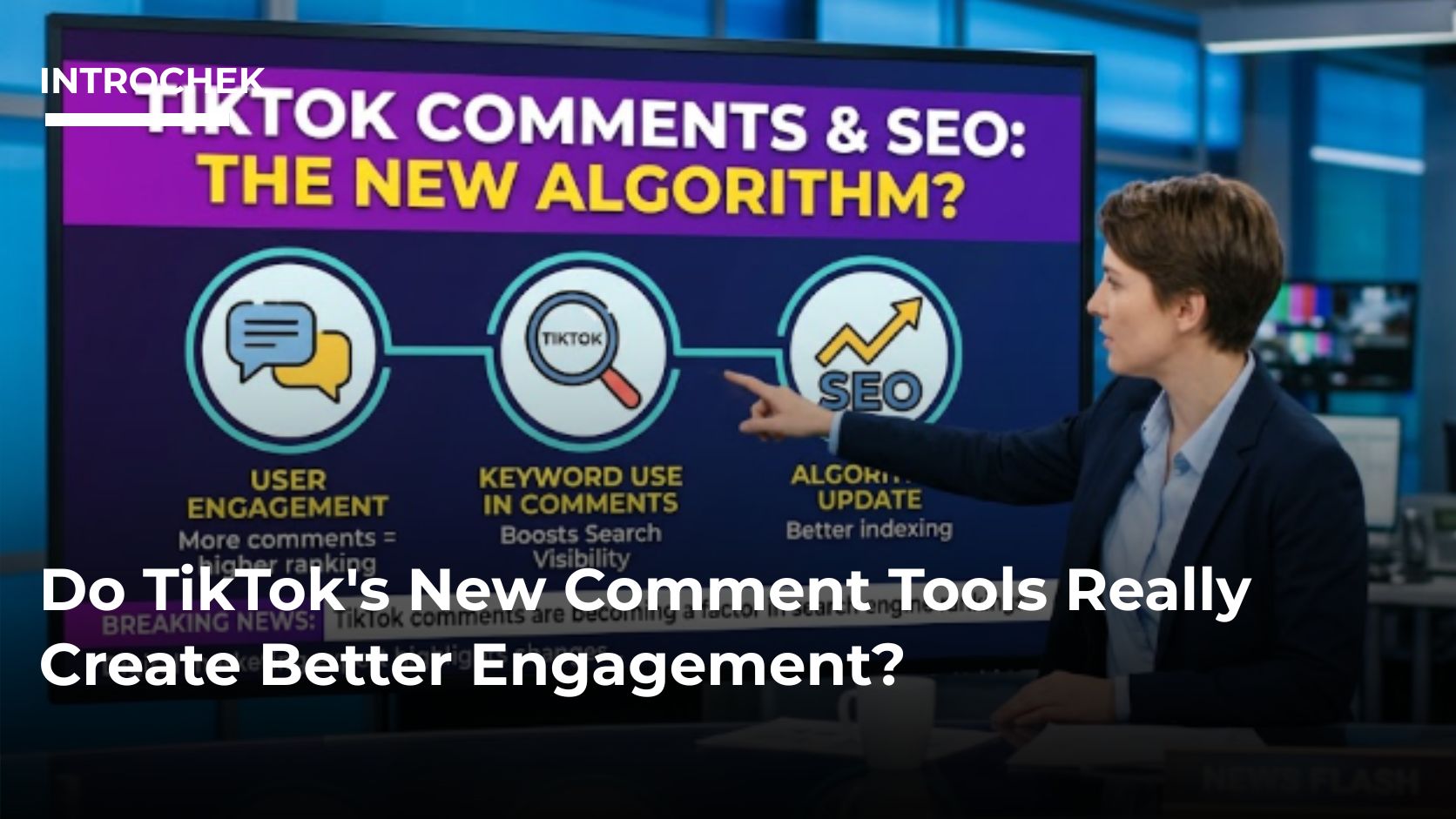
TikTok says its recommendation systems use several categories of information, including user interactions. Depending on the part of the platform, those interactions can include likes, shares, comments, watch completion and content that users skip.
This confirms that interactions are part of the recommendation environment.
It does not establish that comments are always weighted more heavily than views. It does not establish that a poll vote has a specific ranking value. It does not establish that a richer comment thread will cause a predictable increase in distribution.
Businesses should therefore avoid a common marketing shortcut: taking a general statement about engagement signals and turning it into a precise algorithm theory.
The platform does not provide enough information to support that.
A better test is to ask whether the interaction was useful without any algorithm benefit.
Did a poll reveal a preference worth testing? Did a voice response resolve a customer question? Did photo comments provide examples that helped people understand the product?
If yes, the interaction created value on its own.
That is a more defensible business case than promising reach.
TikTok’s own analytics direction is more interesting
TikTok’s Comment Insights feature offers a more substantive clue about where comments may be headed.
Where available, TikTok says Comment Insights can use artificial intelligence to summarize recurring topics, questions and audience suggestions. The feature is subject to market and age restrictions.
That matters because the real business value of comments may be less about the number of replies and more about pattern recognition.
A single question is anecdotal. Twenty versions of the same question may indicate a communication problem.
One customer asking about delivery might be routine. Repeated delivery questions may mean the website is unclear.
One person requesting a product variation may be an outlier. A recurring request could justify a test.
This is where a richer comment section can become useful research input, provided the business keeps the limitations in mind.
The audience is still self-selected. Comments can be disproportionately driven by highly engaged or highly dissatisfied users. The absence of a comment does not mean customers have no concern.
But recurring themes are operational signals worth reviewing.
The moderation cost is part of the equation
Every claim about increased engagement should include the cost of managing it.
Voice comments take longer to review than text. Photo carousels may require image-by-image assessment. Polls can create expectations that the business will respond to the result.
TikTok provides spam filtering, keyword filters and Creator Care Mode, but automated controls do not remove the need for human judgment.
A business that encourages more participation without assigning responsibility may create a worse customer experience.
If a customer takes the time to record a voice question and nobody listens to it, the new feature did not improve engagement.
It simply created a new way to be ignored.
What businesses should test
The most sensible approach is experimentation with defined objectives.
A business can run one poll tied to a real decision and compare the result with sales or other feedback. It can test voice replies on selected customer questions and observe whether they lead to more productive exchanges. It can invite visual contributions where customer examples are genuinely useful.
It should also track the time required to manage those interactions.
The goal is not to prove that every new TikTok feature deserves permanent attention.
The goal is to determine which ones produce enough useful information or customer value to justify the effort.
The update is real. The opportunity is real.
The marketing mythology around it should still be questioned.
TikTok has given businesses more ways to invite participation. That is not the same as giving them guaranteed engagement, reach or revenue.
The difference between those two ideas is where disciplined marketing begins.








Comments are off for this post.